
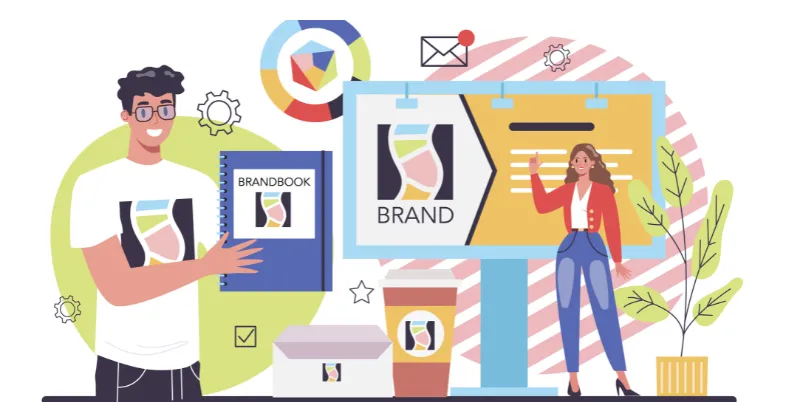
Brand trust is just as important in a B2B context as it is for B2C relationship-building. While it must be underpinned by service excellence and well-managed messaging to promote your offerings and ethos, there’s a place for tangible brand assets in this critical context as well.
Branded items that people can physically interact with are arguably more impactful at the moment than at any point in the past, since the digital-first nature of the world we share today makes them a relative rarity.
You still need to think carefully about what brand assets to invest in to get the best return and create the desired effect, so here are a few of the most compelling examples to inspire your own B2B trust-building efforts.
Here are the 5 Tangible Brand Assets That Boost B2B Trust
1. Challenge Coins
Look into the history behind challenge coins and you’ll learn that they began as a token signifying affiliation within the military, as well as a mark of honor or a signal of achievement in this same context. However, they have since spread to other arenas, and are a useful option for any business that wants to establish and proliferate its brand.
Challenge coins can be completely personalized, so handing them out to specific clients and partners during or after a joint project is an excellent way of forming and reinforcing the bonds between your organizations.
Moreover, because challenge coins are tangible, they are a constant reminder of what they represent, so they have a lasting impact on your brand recognition and the B2B relationships you’ve worked so hard to create.
In order to deploy challenge coins optimally for B2B trust purposes:
- Hand them out at meaningful points, whether in celebration of a specific milestone being reached or in recognition of an event taking place
- Make sure they are accompanied by a personalized note, ideally written by hand, that explains the background of the coin so that the meaning is not forgotten
- Combine physical challenge coin allocation with digital perks. So for instance, if a client has been awarded a bespoke coin in the past, this could allow them to tap into exclusive discounts if they use your online services in the future
2. Onboarding Kits
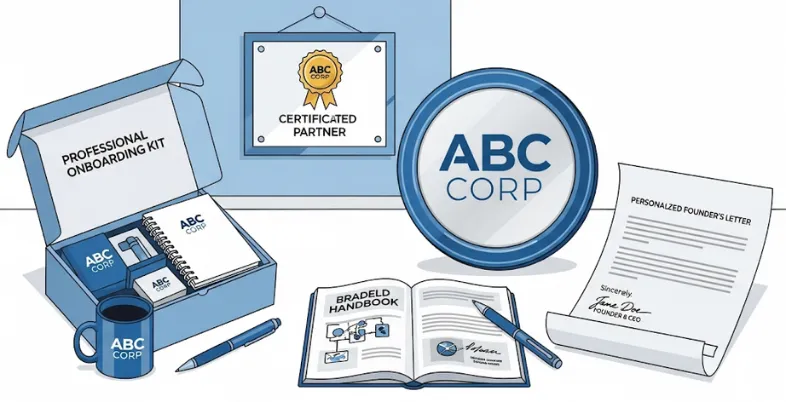
Bringing clients into the fold of your business is a multifaceted process, and you want them to feel welcomed and engaged from the get-go. There are numerous intangible ways to achieve this, just as there’s dedicated onboarding software for the employee side of the equation. However, it’s worth backing up your other strategies with a physical onboarding kit.
The primary purpose of such a kit is to introduce new clients to what your company is all about and lay the foundation for your future relationship. It’s a gesture of generosity and good will, as well as a lens through which the earliest stages of your interactions will be viewed.
For your onboarding kits to hit the mark:
- Make sure they are practical rather than purely aesthetic. That means building in elements like guides to your company’s products and services, tech accessories like water bottles or thumb drivers that are branded but also useful, or merch with your logo that won’t just go to the nearest Goodwill, like umbrellas
- Personalize each kit as much as possible, even if that means writing a unique note to each recipient, so that it doesn’t feel like the whole thing has rolled off a production line with little care
- Don’t forget about the aforementioned usefulness of tying these types o tangible brand assets to your digital resources. Something as simple as including a QR code that links to online info about your business is all that’s required
3. Personalized Founder Letters
We’ve already touched on a few examples of how the personal approach is pivotal to the effectiveness of tangible brand assets, and there’s no better illustration of this than having leaders write personal notes for new clients, as opposed to sending them a generic email greeting.
The fact that so few letters are even used in our increasingly paperless world is enough to make a mailed piece of correspondence feel special. If it’s personalized and signed by the business’s head honcho, it’s all the better. This is just as applicable in a B2C setting as for B2B relationships, since 80% of consumers want personalization from brands they interact with. Thus, the lessons learned here are entirely transferable.
To make a personalized founder letter impactful:
- Adjust the message to align with what’s relevant to the client in question. So if they’re in a specific industry niche, reflect that in the content. And if you know that they have specific goals and criteria they’re working towards, nod to these
- Talk positively about your business and brand, focusing on what it has achieved and accomplished, while also highlighting how its abilities and past successes can benefit the new client.
4. Certification Plaques
Read any guide on how to build a website, and you’ll always see advice about the importance of visual cues in establishing trust with customers online. Displaying security certifications and logos from existing brand tie-ins prominently on home pages and landing pages is web design 101, even if you’re using modern tools.
This is not a new phenomenon, but takes inspiration from the tried-and-tested use of physical plaques showcased proudly on business premises to show that the individual professional or the organization they represent is reputable and trustworthy as a result of their certified expertise.
This applies to everything from industry-specific accreditation to broader options like workplace safety. The point is to provide a conspicuous reminder that the company does not exist in a vacuum, but has actually been scrutinized by independent third parties and been identified as meeting or exceeding certain standards that clients value.
Tangible certification plaques have to be used strategically. To do this:
- Place them in locations where they’ll get the most attention. Entry halls are an obvious choice, but they can also leave a good impression if they are mounted in meeting rooms and other client-facing parts of the premises
- Make reference to new certifications and the plaques celebrating them on your social channels. A picture of a freshly-installed plaque is a straightforward content win
5. Field Handbooks
A branded field handbook is another advantageous brand asset, so it must not be dismissed as unnecessary, even in an era where such resources are usually created and accessed digitally.
As with other talking points we’ve discussed, it’s a good idea to customize field handbooks you create in order to tailor content to individual clients. This is a functional step on the surface, but also benefits your brand by showing how much it cares about individual partnerships.
To make your field handbooks as effective as possible:
- Cite specific case studies for any guidance you give, as this illustrates why it’s worth following
- Optimize the design and language for the purposes of accessibility
- Tie the physical handbook to any digital resources; again, QR codes are your friend, as they’re useful for clients and also a means of helping you measure KPIs for the effectiveness of tangible brand assets effectiveness
The Bottom Line
A mix of tangible brand assets, like challenge coins and field handbooks, alongside digital equivalents, is the best option for modern businesses that want to build and maintain trust in their B2B relationships.
The trust you earn is an asset in its own right, perpetuating the positive reputation of your organization as well as keeping clients on-side for the long term. Thus, tangible assets deserve investment and investigation, regardless of your niche.