
The change from the static and read-only “Web 1.0” to the dynamic and interactive “Web 2.0” has been really big for the internet world. The trend, which was started in the middle of the 2000s, has not only changed the way we consume and produce content but also the SEO game. Generally, the shift from the Internet being a place for user-generated content to one characterized by a variety of blogs, social networking, and collaborative platforms has been acknowledged by most people. The number of internet users has now gone beyond 5 billion, and close to 4.6 billion of these are social media users.
Web 2.0 submission sites with such a large user base are no longer just an optional tool for digital marketers; it has become a powerful necessity. Alongside. They act as a critical link that connects businesses with a vast and captivated audience, thus presenting the chance for establishing brand authority, acquiring backlinks, and getting targeted traffic. The degree to which this move is supported is demonstrated by the evidence of a diverse backlink profile that comprises high-authority web 2.0 sites, which can improve a website’s ranking up to 15-20% in the competitive niches.
To learn more about some of the best Web 2.0 submission websites to keep your seo strategy alive in 2025, please read on.
What is Web 2.0 Submission?

Third-party platforms where users contribute content such as articles, blogs, images, or videos are described as Web 2.0 submissions. These platforms are small websites or personal blogs hosted on significantly authoritative domains. Web 2.0 sites’ characteristic is the aspect of user engagement, which attracts collaboration, branding, and community participation, thus being considered as valuable instruments for SEO and brand visibility.
Key features of Web 2.0 submission sites include:
- User-Generated Content: Individuals are permitted to create and conveniently publish content without the potential restrictions of the platforms.
- Authority Hosting: Although the content is user-generated, it is still hosted on high-domain authority platforms, which results in increased trustworthiness.
- Link Placement: Consequently, content creators are allowed to insert backlinks directing to their primary websites.
- Community Engagement: The inherent audiences and sharing features incite the growth of the reach.
- Versatile Formats: Publications can be in the form of text, images, videos, and infographics that appeal to a broader audience.
SEO Value in 2025
Web 2.0 submissions are, in fact, still relevant in 2025 as a reliable part of an SEO strategy. Their key benefit stems from their ability to supplement backlink profiles with natural, high-authority links. These platforms are like “buffer sites,” which pass link equity to the main website and, hence, back up the site’s authority but in a safe, organic manner. Apart from SEO, Web 2.0 submission can also provide the website with referral traffic, contribute to the branding efforts, and provide the site with social signals, all of which add up to sustainable digital growth.
Why Marketers Still Use Web 2.0 in 2025 Despite Algorithm Shifts
Marketers haven’t completely stopped using Web 2.0 mainly because of several convincing reasons. The main reasons for this are:
- Diversification of Backlink Profile: Building your backlink profile only with one type of link is quite risky. Using links from different sources that also include Web 2.0 submission sites as a part of your backlink profile will make your backlink strategy look more natural and legitimate to search engines.
- Control over Anchor Text: In contrast with guest posts or other outreach techniques, Web 2.0 properties allow you to control the content and anchor text fully. So, you can target the desired keywords more strategically and increase the SEO of your links.
- Structure for Tiered Link Building: A lot of skilled SEO professionals consider Web 2.0 sites as “Tier 1” sources of links. They create backlinks to these Web 2.0 pages, which link further to their leading site, thus spreading the same authority to the leading site. Hence, this is a very effective way of multiplying link equity with minimal risk.
- Brand Building and Authority: As you keep sharing your insights and value-laden content on platforms such as Medium, Blogger, or Quora, you gradually become the authority in your area of expertise. It not only increases the trustworthiness of your brand but also your new audience base.
What Are Web 2.0 Sites?
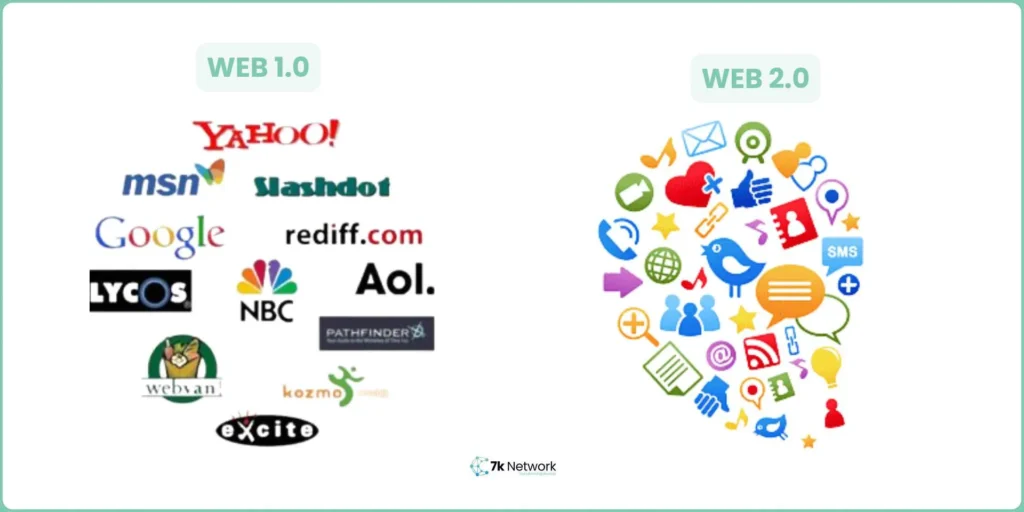
Web 2.0 sites are those that are different from Web 1.0 as they encourage user participation and content generation alongside their social aspect, but maintain most other structural elements and functionalities. The significant difference is that the content is not only visible but also controlled by the users, whereas in Web 1.0, users were only allowed to read. Users of Web 2.0 sites are empowered to be more than just consumers; they are invited and encouraged to become active participants and content creators.
Core Features of Web 2.0 Sites
- User-Generated Content (UGC): This is the hallmark of Web 2.0. Users in the form of articles, videos, images, and comments contribute new content. The notable examples of user-generated content are blogs (Medium), video sharing platforms (YouTube), and forums (Quora).
- Social Interaction and Networking: These sites are built to build communities. Features like comments, likes, shares, and follows encourage users to connect and interact with each other. Platforms like Facebook and Twitter are quintessential examples.
- The Web as a Platform: Rather than a mere page, Web 2.0 sites become a platform for complex, dynamic applications. Technologies such as JavaScript and APIs facilitate real-time user interactions and provide an effortless user experience.
- Collective Intelligence: Numerous Web 2.0 submission sites take advantage of the “wisdom of the crowd” model. For example, Wikipedia is a community of volunteers that grows and maintains an encyclopedia, while Reddit is an upvote system where users decide which content is the most valuable by giving it more visibility.
SEO Benefits of Web 2.0 Submission
Including Web 2.0 submission sites in your SEO strategy offers a wide array of benefits that go beyond simple backlink generation. These benefits include:
- Improved Search Engine Rankings: Links from Web 2.0 sites with a high domain authority are vital ranking signals for search engines. By getting these links, you basically receive a vote of confidence from them, which in turn raises your website’s trust and thus, it gets a better position in SERPs.
- Increased Domain Authority (DA) and Page Authority (PA): Services such as Blogger and WordPress have extremely high DA and PA scores. Consequently, a link from one of these sites can send you a lot of power, thus improving your domain’s overall ranking.
- Targeted Referral Traffic: If you come up with a quality Web 2.0 submission article that is closely related to your niche, you can draw the attention of a very targeted audience who are already interested in what you have to say. This kind of referral traffic is usually more convertible to leads or sales.
- Brand Building and Awareness: The constant appearance in various Web 2.0 submission communities will lead to better brand recognition and authority. Every piece of content you publish is a mini billboard for your brand, presenting it to new people and strengthening your online reputation further.
- Increased Indexing: Making content for these platforms can speed up the process of search engines finding and indexing your site pages. When a user visits a high-authority Web 2.0 page and finds a link to your site, they will most likely see your site as well.
- Social Signals and Engagement: The engagement with these platforms is a source of social signals, likes, shares, and comments that can have an indirect effect on search rankings. Even though they are not a direct ranking factor, strong social signals show popularity and relevance, which search engines often take into account.
Top 50 Web 2.0 Submission Sites with DA 90+
List of High DA Web 2.0 Sites
Few DO-Follow Web 2.0 Sites List
Key SEO Metrics to Evaluate Web 2.0 Sites: Choose a Right Site
To build a successful campaign, it is very necessary to pick the right Web 2.0 sites to submit your content. Here are the key metrics to evaluate them:
- Domain Authority (DA) and Page Authority (PA): These are metrics from Moz that are used to predict how well a website will rank on a search engine results page. The higher the score (e.g., DA 50+), the more it is said to be a site of authority and trust, making the backlink of it more valuable.
- Spam Score: It is a Moz metric that varies from 0 to 17 and indicates the number of “spam flags” on a site. Try to use sites with a low spam score (less than 5) to avoid affecting your SEO negatively.
- Domain Rating (DR) and URL Rating (UR): These are the metrics provided by Ahrefs that indicate a website’s backlink profile strength and a particular page’s backlink profile strength, respectively. Just like DA, higher DR and UR are more preferable.
- Relevance: The importance of the platform in your niche is equal to its authority. A link from a tech blog with high authority is more valuable than a link from a fashion blog to a software company.
- Do-Follow vs. No-Follow Links: Although do-follow links allow the direct passing of link equity, no-follow links are still valuable. They can generate referral traffic and be part of a natural backlink profile. The combination of the two is the best one.
How to Create Powerful Web 2.0 Backlinks (Step-by-Step)
The only way to earn Web 2.0 backlinks that lead to your success is not by randomly posting articles. The max SEO value can be attained only through a carefully planned approach that balances quality, relevance, and engagement. The primary steps involved in generating potent Web 2.0 backlinks are given below:
1. Select the Right Platforms
Strong backlinks begin at the base of the platform choice. You should:
- Target 5 to 10 well-known, high-domain authority Web 2.0 sites with good reputations.
- Pick platforms related to your niche for greater topical relevance.
- Give quality a priority to platforms rather than an absolute number of them to avoid signaling spamming
Backlinks from credible platforms weigh more in Google’s eyes compared to numerous links from low-quality sources.
2. Create a Unique Profile
Making a profile is the first step towards being respectable. To make it perfect:
- Create a professional username and use a definite profile picture.
- Compose a keyword-rich but natural bio that is representative of your niche.
- If allowed, add a link to your main website in your profile.
Well-made profiles communicate legitimacy both to users and search engines.
3. Plan and Publish Quality Content
The main thing in Web 2.0 submissions is content. For best results:
- Produce 500 words or more of unique and helpful content.
- Center the content around teaching, problem-solving, or giving the audience some new perspectives that are relevant to them.
- Make sure the content is well-researched and has no plagiarized parts.
High-quality content will not only rank better but also attract organic engagement and sharing.
4. Strategically Place Backlinks
The main issue with a backlink is where you put it. It is not just about stuffing the backlinks. Here are some tips:
- Insert your link in a casual and logical way in the article.
- Make the anchor text descriptive, relevant, and varied, i.e., do not use exact-match keywords only.
- Do not excessively use backlinks in one article to avoid getting spammed.
With such a method, the search engines will consider your links as part of the editorial and thus will find them reliable.
5. Add Multimedia and Structure
A well-planned content format keeps readers interested and establishes trust. To boost presentation:
- Use headings, subheadings, and bullet points to make the content more straightforward.
- Put pictures, videos, or infographics that are relevant to your topic.
- Make sure that the content is formatted correctly so that it is easily readable on any device.
The use of structure and multimedia not only increases user engagement but also adds SEO value.
6. Maintain and Update Content
Web 2.0 submissions are not just “one-and-done.” To keep them efficient:
- Involving yourself in the community by replying to comments and engaging the readers.
- Update the articles with new information regularly.
- Keep the content up to date by adding new images or insights.
Regular updates signal to both users and search engines that your content is current and valuable.
These Web 2.0 backlink steps can be a powerful SEO asset when used correctly by increasing rankings, building authority, and generating referral traffic in 2025.
Advanced Link Building with Web 2.0 (Pro Strategies)
If you want to move your Web 2.0 strategy beyond the basics, you can try these advanced tactics.
Tiered Link Building
- Tier 1: Publish high-quality content on a handful of high-authority Web 2.0 sites (like Medium, WordPress) and put your money site as the direct recipient for outgoing links from these pages.
- Tier 2: Use other, lower-authority Web 2.0 sites, social media shares, and directory submissions to create backlinks to your Tier 1 pages. Backlinks to your Tier 1 pages are what bring you the next step.
Pillar Content Strategy
Take on a high-authority Web 2.0 platform and create a long, detailed “pillar” article like the ultimate guide on a niche topic.
Replicate Your Website's Silo Structure
While you have organized your leading site into clusters, the same thing can be done on the Web 2.0 submission side. Build a network of linked Web 2.0 properties that are topically related to each other, and thus, you are more authoritative in that broader topic.
Risks & Mistakes to Avoid
Even though Web 2.0 submission is a fantastic tool, if it’s misused, it may result in mistakes. Be careful not to make the following errors:
- Overstuffing Keywords: Do not fill the web content with the phrase “web 2.0 submission sites”. Write naturally and focus on quality. Search engines are smart enough to understand the context.
- Spammy Links: Do not create a plethora of low-quality, irrelevant links. Numerous unauthorized links of low quality are a typical black-hat SEO that will put you at risk of penalization. Always take the quality over quantity route.
- Duplicate Content: Never copy and replicate content from your leading site to a Web 2.0 platform. Search engines can even go as far as to punish sites for duplicate content. Always produce unique content for every platform.
- Ignoring User Engagement: Just posting content and then immediately leaving is a lost opportunity. Take part in conversations, respond to comments, and encourage a community to grow around your content.
- Using a Single Anchor Text: Avoid using the same keyword for every backlink you create. Instead, employ a mix of different types of anchor texts, namely branded, generic, and long-tail keywords, for your backlink profile to have a natural appearance.
Measuring Web 2.0 SEO Impact
If you want to find out if your work is returning its value, it is necessary to check the influence of your Web 2.0 submission sites. This can be achieved through the following method:
- Monitor Search Rankings: You can track your website’s keyword rankings with the help of SEMrush, Ahrefs, or Moz. Try to find increases that point to your Web 2.0 link-building initiatives.
- Analyze Referral Traffic: Examine your Google Analytics and find out the amount of traffic that your website has gained from your Web 2.0 properties. The number of visitors coming from those platforms is a direct measure of the effectiveness of your content on those platforms.
- Track Authority Metrics: Be sure to check your website’s DA, PA, and DR regularly. These metrics can change, but if the general trend is going up, it is a strong indication that your link-building strategy is working.
- Check for Indexing: Check if your content can be accessed by the search engines using a site-specific search query (site:yourweb20domain.com). If it is not, then you should promote the page to encourage crawling.
Conclusion
In 2025, Web 2.0 submission sites are still very much a part of the game, but with some changes to the rules of the game. They are no longer a single-strike weapon, but, if used prudently and ethically, they can not only be a potential significant resource to your authority, targeted traffic, and backlink profile but also become a mainstay for you. The essential aspect is to transform your perspective of just another link-building activity into one of brand-building and content marketing.
Producing quality and helpful content on high authority platforms makes you not only compliant with the search engine algorithms, but it also makes you a player in the game of engagement with your audience. This dual strategy confirms that your efforts will be long-lasting and effective.
FAQs
Q. What is the main difference between Web 1.0, Web 2.0, and Web 3.0?
The key difference is the degree of user interaction and control. Web 1.0 was a “read-only” web where the content was static, and users were passive consumers. Web 2.0 is the “read-write” or social web, where users collaboratively and socially share and edit content via centralized platforms. Web 3.0 is the developing “read-write-own” web that is centered on empowerment by providing users more control and ownership of their data through means such as blockchain and AI.
Q. What kinds of content can be published on Web 2.0 sites?
You may publish any content you want to, such as articles, blog posts, videos, infographics, and images. The most suitable format is decided by the particular platform and the audience you are trying to reach.
Q. Are Web 2.0 submission sites still a good way to get backlinks in 2025?
They are, but the catch is that you need to use them properly. Set the goal of publishing small amounts of high-quality, unique content on a few high-authority platforms that are relevant to your niche. Stay away from activities like spamming and producing low-quality content.
Q. How often should I submit content to Web 2.0 sites?
There is no one right for this. It depends on your overall SEO and content strategy. A good practice is to create a new piece of content for a Web 2.0 site every time you publish a significant article or piece of content on your main website.
Q. Is it better to have do-follow or no-follow links from Web 2.0 sites?
While direct link do-follow links transfer link equity, a healthy backlink profile is a balanced mix of both types. No-follow links from high-traffic, relevant sites can still bring you a lot of referral traffic and make your link profile look natural.