
Launching a business may seem like a giant leap, but when dealing with the cleaning business, the grounds are far better established. Whether you are a lone businessman with a vacuum and a dream or the person desiring to form a large crew, the issue of whether it could generate revenues or not is always the primary one.
This guide will demonstrate to you what the cleaning business is actually like. We will tell the actual figures, the most appropriate kind of clean-up to select, and an elaborated road map to assist you in creating a Cleaning Business Plan that really works.
Provided that you believe that cleaning is simply a side hustle, you are mistaken. The industry has turned out to be a massive figure in the American economy. The following are four major facts to demonstrate the size of this opportunity:
The market of the U.S. contract cleaning services is anticipated to reach approximately 100.5 billion dollars by 2026 and is continuously increasing. Cleaning businesses typically record net profit margins of between 10 and 28 per cent, on average, and are far superior to most service sectors, such as retail or food service.
However, it is important to note that it is easy to enter the business of residential cleaning with less than 2,500 USD, including all basic supplies, insurance, and initial marketing. For anyone starting out, a well-prepared cleaning company business plan can help outline costs, target clients, and growth strategies. In the industry, some 80 per cent of the revenue comes from repeat customers, which implies that once you have a client, they tend to be a dependable monthly source of revenue.
Is a Cleaning Business Profitable?
The short answer? Yes. The more complex answer to this question is that it is profitable because you want it to be. There is no point in making profits in this business based on the intensity of your scrubbing; it is about using your time and your staff intelligently.
Huge Demand and Low Recession
Cleaning is a business that stays strong even in tough times. Offices must follow health rules, and busy families still need clean homes. In 2026, people are willing to pay more for services that make their spaces healthy. The global cleaning market is about $472 billion, with commercial cleaning alone valued at $298 billion, indicating strong, steady demand.
Low Overhead Costs
You don’t need a big shop or fancy kitchen to run a cleaning business. Most costs are labour (50–70%) and supplies (5–10%), so you keep a bigger portion of what you earn. Depending on the service, net profits range from 10% to 35%, making it easier for small business owners to earn a good income.
Scalability: From One to Many
When you hire a team, your income isn’t limited to your own hours. A small team of 5–10 workers can generate the owner’s six-figure profits, mainly by taking on more jobs. Small commercial teams can make $70,000–$120,000 a year, and bigger operations can reach $500,000+ with 20–25% profit margins.
The Power of Systems
Using scheduling, invoicing, and GPS software helps reduce wasted time. This lets you serve more clients without extra effort. Sound systems can also help speciality services like medical or post-construction cleaning reach 20–35% profit margins, while regular residential cleaning usually earns 10–18%.
Types of Cleaning Businesses That Make the Most Money
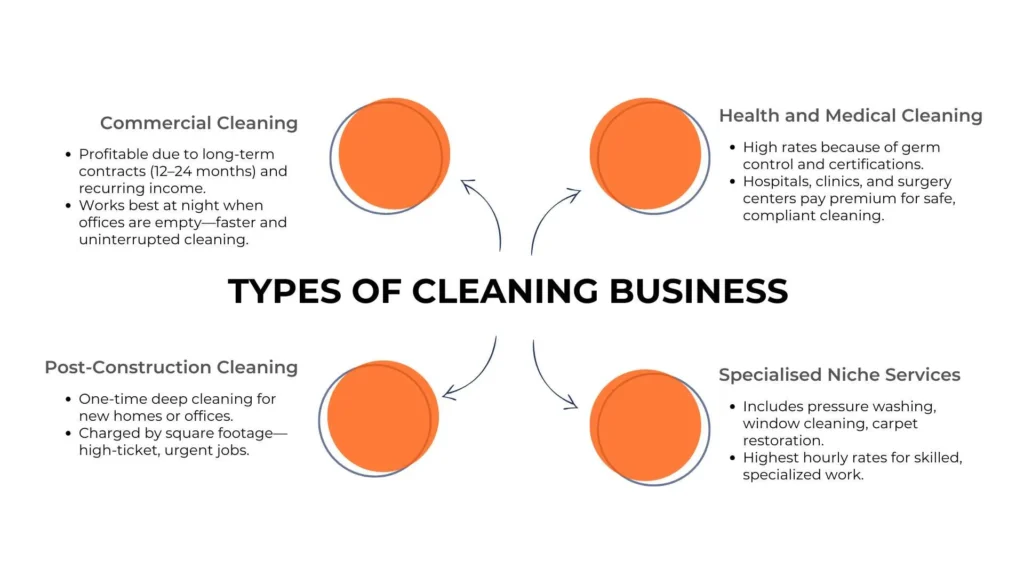
Cleaning does not cost the same amount of money. It takes more talent or more equipment, and those tend to be the most lucrative.
1. Commercial Cleaning ( janitorial services)
Large amounts of money are usually found here. Commercial cleaning provides offices, warehouses and retail areas.
- Why it is profitable: You are not cleaning once; you conclude 12-month or 24-month contracts, which will provide you with a constant inflow of cash.
- The Edge: As the building is empty at night, you will be able to clean, and your team will be able to work more quickly without any interruptions.
2. Health and Medical Cleaning.
The office of a doctor or the surgery centre should be properly informed about germs and how to prevent cross-contamination.
- Why it is profitable: Since it is a high-risk business, you can charge very high rates. Facilities pay a higher price to a certified team that does not put them in trouble with the health inspectors.
3. Post‑Construction Cleaning
When a new house or office is completed, it is loaded with dust and stickers, and debris is all over.
- Why it is profitable: It is a single deep cleaning that will require the contractors to hurry to deliver the keys. Another way to charge is frequently by the square foot, and that creates high-ticket jobs.
4. Specialised Niche Services
The hourly rates are usually the highest for services such as pressure washing, window cleaning, or carpet restoration. Whereas an ordinary house cleaning would cost about 40-60 an hour per cleaner, a specialised job, due to the special equipment required, could be billed very easily at 100 or more an hour.
Licenses and Legal Requirements
You should see that Uncle Sam is pleased before you take a mop. Working under the carpet may seem easy, but you may lose the chance of getting the best clients and endanger your personal assets.
1. Business Registration
You must choose a legal organisation. The majority of small cleaning ventures begin as an LLC (Limited Liability Company). This is in order to keep your personal and your business money separate. In case one falls on the wet floor and sues the business, your personal home and vehicle are usually insured.
2. General Business License
A lot of cities and counties have a basic business license or Vendor’s License in order to work. This is typically a simple and modest yearly charge (usually $50-100).
3. EIN (Employer Identification Number)
Imagine this is some sort of social security number for your business. The IRS (free of charge) will require this to open a business bank account and employ staff.
4. Insurance and Bonding
This cannot be compromised in case you are in business to make a profit.
- General Liability Insurance: This type of insurance protects a client’s property (e.g., if you bleach a rug).
- Surety Bond: This safeguard protects the client in the event of employee embezzlement. The fact that you are licensed, bonded, and Insured is a significant selling point that enables you to charge higher rates.
- Workers’ Comp: Workers’ Comp is a required policy in most states when you have hired your first employee.
Step-by-Step Guide to Writing a Cleaning Business Plan for 2026
A Cleaning Business Plan is more than a bank document; it is your roadmap. In its absence, you only drive around hoping to get a customer. The following outlines how to create a 2026-ready plan.
1. Executive Summary
This is your elevator pitch on your business. Given that a busy investor or a spouse has no more than two minutes to read, what would he/she need to know?
The following reason causes this:
- Mission Statement: What is your purpose in doing so? (e.g., To offer eco-friendly and reliable cleaning to busy families in the Austin area.)
- High-Level Goals: What do you want to be in 12 months? 3 years?
2. Business Description
Explain the where and the who of your company.
- Ownership: Who is the owner of the company? What is their experience?
- Legal Organisation: Is it an LLC or a Sole Proprietorship?
- Location: Will it be home-based, or will you rent a small warehouse?
3. Market Analysis
You must demonstrate that you have people who are ready to pay you.
- Target Audience: Do not say everybody. Do you focus on dual-income families? Luxury apartments? Small law firms?
- The following are some examples of competitor research: What are they missing? Perhaps they lack an online booking system, or they rely on harsh chemicals. That’s your opening.
4. Services Offered
Be specific. But not cleaning, but your menus.
- Standard Clean: Cleaning, vacuuming, mopping.
- Deep Clean: Ovens, behind appliances.
- Add-ons: interior fridge cleaning, laundry, and window track.
- Price: How will you be pricing (by hour, charge per home, or charge per square foot)?
| Service Type | Average U.S. Price (Typical Range) |
|---|---|
| Standard Home Cleaning | $120 – $250 per visit (residential) |
| Deep Cleaning | Higher premium (7% growth trend) |
| Move‑In/Move‑Out Cleaning | ~$150 – $350 per visit |
| Commercial Office Cleaning | Contract pricing varies by square footage |
5. Marketing and Sales Strategy.
How will people find you?
- Digital Presence: A sleek mobile site with an instant quote button is essential in 2026.
- SEO: You will rank on Google by targeting such a keyword as House cleaning in [Your City]
- Referral Programs: Gift your existing customers a $20 discount for each referral they make. The most affordable marketing you will receive is through word-of-mouth.
6. Operational Plan
This is how your day-to-day life is.
- Equipment: Add your vacuums (HEPA filters are now required), microfiber cloths, and environmentally friendly solutions.
- Staffing: How will you recruit cleaners? What will you do to train them to maintain quality?
- Technology: What software will you use to schedule? (The industry favourites are such tools as Jobber or Housecall Pro.)
Labor is a major cost (55–65% of revenue in residential cleaning).
7. Financial Plan
The most significant one to profit from.
- Start-up Costs: Record all the pennies you have to spend before your first job.
- Breakeven Analysis: What is your break-even point? How many homes do you need to clean per month to break even?
- Projected earnings: Your first year’s projected earnings. Be realistic!
8. Funding Requirements
Here, you can apply for a loan. Be explicit on what the money will be utilised fo,r maybe a wrapped van or a grandiose marketing program.
Tips to Make Your Cleaning Business Plan Stand Out
This is how you can make your cleaning business stand out and become the most discussed in your city.
1. Learn the Customer Experience, not the Clean.
Most cleaning companies focus only on the floor, not on how customers feel. The little things can be enhanced to make you stand out.
- The Notification System: When the cleaner is on her way, a message and a photo of the team; when the job is done, a message and a photo of the team.
- The Wow Factor: Have a little marker at the conclusion of each visit. This may be a folded piece of toilet paper, a chocolate with a brand name on the kitchen counter, or a small report card listing what was actually cleaned. These minor gestures help customers feel acknowledged and that you are concerned.
2. Specialize in a “Hero” Niche
When you attempt to become the best for everybody, you become the best to nobody. Focus on a specific group.
- The Eco-Warrior: Only buy non-toxic products that are made of plastic and are not plants. Position yourself to parents of newborns or pet owners concerned about chemical use.
- The Move-Out Experts: Collaborate with local realtors and provide them with a service known as a Guaranteed Deposit Back. Knowing how to deep-clean a place when it has to be moved out, you are the guru that everyone would go to when it matters.
3. Build a “Human” Brand
Individuals prefer to employ individuals whom they know and not an organisation that does not have a face. There are a number of sites that employ generic stock photographs that convey no information.
- Use Real Photos: Have your real team (uniformed) on your website and your social media.
- Share Your Story: Provide the reasons why you created the business. Perhaps it was due to the fact that you were able to witness the level of stress experienced by your own parents as they attempted to keep up with housework. That relationship creates an emotional value and renders it difficult to change to a less expensive rival.
4. Use “Smart” Technology
In 2026, convenience is a currency. When a customer has to call you and wait for a callback, only to receive a price quote, you have already lost.
- Instant Online Booking: Your site must allow a client to select their house size, price, and slot in under 60 seconds.
- Digital Checklists: For each case, email the client a digital before-and-after checklist with photos after the job is completed. This openness removes uncertainty about whether a cleanup occurred.
5. Invest in Your Team (The Happy Cleaner Theory).
The most significant grievances in this industry are high turnover and poor intermittent quality—nurtured by doing employees right. Compensate with a living wage and develop a favorable culture. A satisfied house cleaner is pleasant to clients, attentive to detail, and will stay with you for years. Clients enjoy the same familiarity with the same face each time they visit. You have a massive advantage of consistency.
6. Violent Review Administration.
Everything in the US market is social proof. A firm with 150 five-star reviews can charge 20 per cent more than one with 10. Hopefully, you will not wait until you are reviewed, but will become part of the process. Provide a minor reward to your employees each time they make five-star reviews by name. This will make excellence a game and will ensure that your Google Business Profile remains at the top of a search.
By focusing on these high-value areas, you cease competing on price and begin competing on value. Profitability takes care of itself when you are the most convenient, transparent, and human choice.
Also Read: Laundromat Business Plan for Beginners
Conclusion
Is a cleaning business good money? Absolutely. It is a low-risk/high-reward industry that is rewarding due diligence and intelligent systems. It can turn a bucket and a mop into a valuable, scalable enterprise by choosing a lucrative niche, maintaining proper documentation, and implementing a strong strategy. The business is available — just show up and perform.
FAQs
What is the potential in the earnings of a cleaning business owner?
A lone cleaner earns between 50k and 70k, and owners of small agencies with staff usually realise profits ranging between 100k and 300k plus in the process of growth.
Should houses or offices be cleaned more thoroughly?
Commercial (offices) tend to be more stable and have longer-term contracts, while residential (houses) are simpler to begin with and have shorter sales periods.
Am I required to have a lot of equipment to begin with?
No. To start, one only needs a professional vacuum, several spray bottles, and high-quality microfiber cloths for under $500.
What is my price policy on cleaning services?
The majority of pros charge between $40 and $90 per cleaner hour, though a flat rate based on the number of bedrooms and bathrooms is also accepted.