
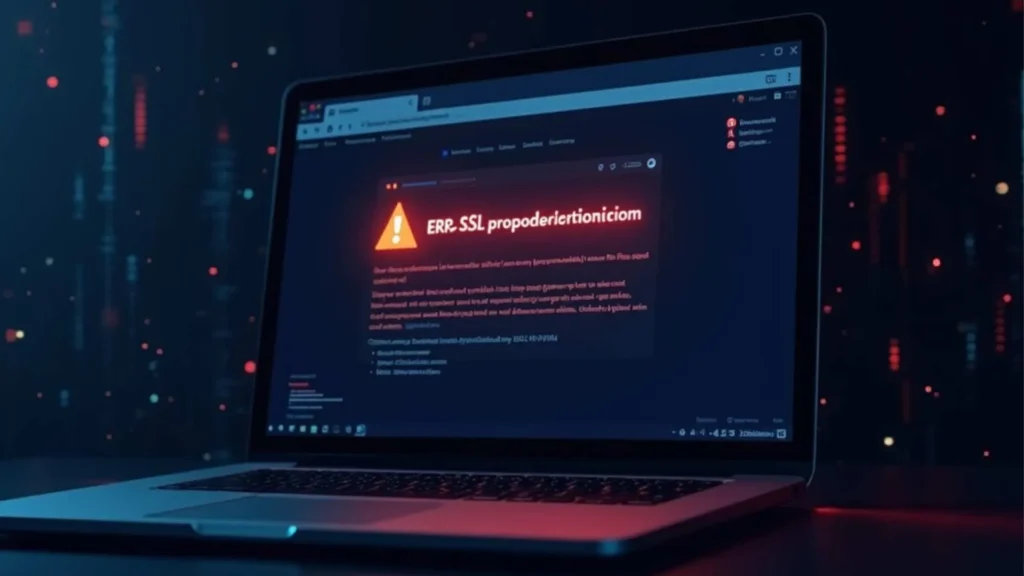
Picture this. You open your browser, go to a website address, and there is no site loading boom. You receive a massive red message with the text ERR_SSL_PROTOCOL_ERROR. Frustrating, right?
You’re not alone. The mistake is one of the most common browser errors that individuals would encounter in 2026. The following is a bit of fast data to demonstrate to you the sheer extent of the problem of SSL:
Most websites currently (more than 95% of the websites) have employed HTTPS (SSL-secured connections) as compared to half a decade ago (50% of the websites). It implies that there are a number of errors in the use of SSL, as never previously seen.
As the Google Transparency Report 2025 reports, millions of insecure connections are blocked by Chrome each day to ensure the safety of people. Cloudflare conducted a survey in 2024, which revealed that the misconfiguration of the SSL/TLS is one of the 3 most common causes that make websites unavailable or down.
Older versions of the SSL / TLS protocol (such as TLS 1.0 and 1.1) are formally decommissioned in all leading browsers (Chrome, Firefox, Edge, and Safari), which has resulted in an abrupt rise in the number of users who see an error when accessing older or poorly maintained websites.
Whether you are simply surfing the web, running a WordPress blog, or a business site, everyone can make this mistake. The good news? It’s almost always fixable. Nor do you have to be a tech expert in order to fix it. We can all be systematic about it, beginning and ending, why and how it ought to be.
What Is the ERR_SSL_PROTOCOL_ERROR?
ERR_SSL_PROTOCOL_ERROR is a browser error message, which informs you of one thing: your browser attempted to connect to a site, and the process failed in some way.
SSL is an acronym used to denote Secure Socket Layer. The technology is what forms a secure, encrypted connection between your browser and a website. Imagine it as a handshake, your web browser extends its hand, the website accepts, and the two of you agree upon how to communicate safely.
In case such a handshake is not successful, whatever the reason is, your browser explodes and denies you entry to the location. This mistake will be predominant in Google Chrome, but can also happen in Edge, Firefox, and other browsers (with variations in the names).
What Does ERR_SSL_PROTOCOL_ERROR Mean?
In everyday language, this is translated as: your web browser and the website were unable to come to an understanding of the means by which they could communicate safely.
This might mean a number of things specifically: The site does not have an active SSL certificate, or it is expired or broken.
Your security settings on your browser are preventing the connection. Your server is not compatible with whatever your browser is good with. One of the things on your machine (such as your system clock or an antivirus) is disrupting the SSL handshake.
It does not imply that the site is unsafe in any way. You have problems on both sides. Sometimes it is something on your side — your browser, your settings, your network.
Why does ERR_SSL_PROTOCOL_ERROR occur?
The following are the most frequent ways that this error manifests itself:
SSL certificates are time-sensitive. When your clock in your computer is also misplaced, then the browser will assume the certificate has expired or has not yet been activated.
- Corrupted browser cache: Data in a browser cache is old and may conflict with new certificates. Your browser gets confused.
- Old browsers: Older browsers do not use newer versions of TLS. The standard in 2026 is TLS 1.3, and many websites have abandoned the older standards completely.
- Browsers interfering: HTTPS browser extensions like ad blockers or security extensions intercept HTTPS connections and lead to an error with the SSL.
- Security software blocking: with an antivirus or firewall, will occasionally undertake what is known as SSL scanning, which will sever the connection.
- Older versions of the SSL/TLS protocol: Older browsers and operating systems default to TLS 1.0 or 1.1; these are the old versions of the protocols used for connections that are no longer supported by modern servers.
- Website-side issues: The site may either be running an out-of-date server, or it may be having a mixed content error.
Quick Fixes (Try These First)
These are some of the quick things that one should first attempt before taking these steps into detail. They correct the situation of the majority:
Reload the page. It can be reloaded hard by either pressing Ctrl + Shift + R (Windows) or Cmd + Shift + R (Mac). Test another browser. If Chrome is giving the error, but Firefox is working correctly, it is a browser issue.
How to Fix ERR_SSL_PROTOCOL_ERROR (Step-by-Step)
Step 1: Check Date & Time
This is the first reason that the majority are not taking this into consideration.
On Windows:
- Click on the clock on the right-hand corner at the bottom.
- Click “Adjust date/time”
- The switch to automatically set the time should be turned on.
- Click “Sync now”
On Mac:
- Click on System Settings, then General, then Date and Time.
- Ensure that the setting time and date are set automatically.
On Android:
- Click on Settings -general management (date and time).
- Switch on automatic date and time.
- After making a correction of the time, you need to reload the page. This in itself corrects the mistakes of quite a few individuals.
Step 2: Clear Browser Cache
SSL data stored in the cache can be conflicting. The way to clear it in Chrome is the following:
- Install Open Chrome and command Ctrl + Shift + Delete (Windows) or `Cmd + Shift + Delete (Mac).
- Set time range to “All time”
- Check Cookies and other site data. Check Cached images and files
- Click “Clear data”
- Then try the website again.
And also you can clear the state of the SSL specifically:
On Windows:
- Go to Chrome Settings (open) Privacy and Security.
- Or go to Control Panel- > Internet option- >contents tab- >”Clear SSL State”
Step 3: Update Your Browser
Nobody wants to run a browser that is out of date in 2026: this is a real security hazard, and it even renders the browser unable to give an SSL certificate.
To update Chrome:
- A menu on the three dots (top right) is tapped.
- Make Help About Google Chrome.
- Chrome will update itself automatically.
- In case there is an update, install it and restart the browser.
- Firefox users: Help About Firefox. Edge users: Click on settings. On the right side, there is an About Microsoft Edge.
Step 4: Disable Extensions
Extensions, VPNs, ad blockers, and security applications in particular can tamper with the connection of the SS.
To test whether the problem is an extension:
- Main steps: Press the keys Ctrl + Shift + N to open an Incognito window.
- Test the site; when it does not work, it is an extension that is to blame.
To disable all extensions:
- Go to chrome://extensions/
- Unless all the extensions, switch them off.
- After each of them, reload the site to find the bad actor.
- When you are there, you can either delete it or update that extension.
Step 5: Check SSL/TLS Settings
This error on the websites of the modern web will occur when your browser or Windows is configured to use outdated TLS protocols.
On Windows (Internet Options):
- Click on Windows + R, enter inetcpl.cpl, and press Enter.
- Go to the Advanced tab
- Scroll down and make sure:
- TLS 1.2 is checked
- TLS 1.3 is checked
- SSL 3.0 is unchecked
- TLS 1.0 and 1.1 are also unverifiable in uncheckedness (deprecated in 2026).
- Click Apply, then OK
- Restart your browser
Fix ERR_SSL_PROTOCOL_ERROR in Chrome
This error manifests itself most frequently in Chrome. The users of Chrome have a focused fix list targeted here:
- Clear SSL State: Chrome Settings: Privacy-> Security- Manage Certificates-> Clear SSL State (On Windows: Internet options- content)
- Clear Chrome settings: Enter chrome in the address bar, scroll up, and forget everything by clicking the Reset all button at the top.
- Turn off QUIC protocol: Go to the address bar and enter chrome://flags/#enable-quic and change it to Disabled and restart Chrome.
- Security level of Check Chrome: Click on Settings, then Privacy and Security, then Security, then ensure that you are under Standard protection and not under No protection.
- Restore Chrome settings: Click on Settings-> Restore settings to original defaults.
- Reinstall Chrome: In case nothing helps, uninstall Chrome, download a new one from google.com/chrome, and restart.
Fix ERR_SSL_PROTOCOL_ERROR on Android & iPhone
The errors in Mobile SSL are slightly different. Here’s what to do:
On Android:
- Open General management, then Date and Time, and turn on the option of Automatic.
- Open Chrome → Settings Privacy →Clear Browsing Data →Select all the options therein →Clear Data
- Access Settings and go to Apps, then into Chrome, and then Storage and Clear Cache.
- Turn off any VPN apps
- Forget the WiFi network and reconnect.
- Play Store update Chrome.
On iPhone (iOS):
- On Settings→ General → Date & time → turn on Set Automatically.
- Open Safari or Chrome → clear history and website data
- Go to Settings → VPN — turn off any active VPN
- Open the Settings, go to the General section, then Reset, then Reset Network Settings (this will delete passwords of previously used WiFi networks).
- Refreshing your browser on the App Store.
Fix ERR_SSL_PROTOCOL_ERROR on Edge & Other Browsers
Microsoft Edge:
- Click the three dots → Settings → Privacy, search, and services
- Move the cursor to the Clear browsing data option, select what you want to clear, and then click on the Clear now button.
- Go to edge://flags, click Reset all
- Open Windows Internet Options / Advanced / be sure that TLS 1.2 and 1.3 are on.
- Update Edge: Setting → Help and feedback → About Microsoft Edge
Firefox:
- Go to typing:about: config in the address bar→ continue with the warning.
- Search for security.tls.version.min → ensure that it is 3 (i.e., TLS 1.2)
- Search for security.tls.version.max → set it to 4 (TLS 1.3)
- Clear the cache of Firefox: Settings → Privacy and Security →Clear Data.
ERR_SSL_PROTOCOL_ERROR on All Browsers (Advanced Fix)
In case the error is displayed in Chrome, Edge, Firefox, and all the other browsers, the issue is probably at the system or network layer.
Flush DNS Cache: Open Commands Flush DNS Cache Open Command – ipconfig /flushdns
On Mac, open Terminal and type:
sudo dscacheutil -flushcache; sudo killall -HUP mDNSResponder
- Reset TCP/IP Stack (Windows only): Open Command prompt (as an administrator) and type in the following one at a time:
netsh winsock reset
netsh int ip reset
ipconfig /release
ipconfig /renew
ipconfig /flushdns
Restart your computer after.
- Change Your DNS Server: It is possible that your ISP’s DNS is having problems. Switch to Google’s DNS:
- Primary: 8.8.8.8
- Secondary: 8.8.4.4
- Or use Cloudflare’s DNS: 1.1.1.1
Select Network Settings and then Adapter settings, and manually enter in IPv4 Properties.
- Disable Antivirus SSL Scanning: Antivirus SSL Scanners such as Avast, Kaspersky, and Bitdefender are enabled with an “SSL scanning” or “HTTPS scanning” feature that is used to intercept the connection in the form of an SSL connection. Turn this off temporarily:
- Avast: Protection, Core Shields, switch off HTTPS Scanning.
- Kaspersky: Settings/ Network Settings/ Turn off/ switch off encrypted connections scanning.
ERR_SSL Protocol_Error on Wifi Networks
In other cases, it is the network itself that is the issue, such as in public WiFi, school networks, or the office network.
Try these steps:
- Change to mobile data, in case the site loads on mobile data, you have an issue with your WiFi network.
- Use VPN — a sufficiently secure VPN, such as ProtonVPN or Mullvad, will go around the network-level interference with SSL.
- Reconnect to WiFi, Unremember and reconnect to the WiFi, WiFi Settings Forget Network
- Test of a captive portal, there are networks that will not allow you to browse before you log in. Visit any non- HTTPS page (such as http://example.com) to check whether it features a login page.
- Ask your IT guy/girl (assuming a workplace or school network, the firewall might be blocking some certificates in its SSL). Your administration is capable of whitelisting the site.
Error ERR_SSL_PROTOCOL_ERROR in WordPress
When you are operating a WordPress website, and your visitors are getting this error, it is likely to be on your server side.
Typical WordPress errors and resolutions in the area of SSL:
- SSL certificate expired: Log in to your hosting control panel (cPanel, Plesk, or other). Check the section of the SSL and renew your certificate. Most of the hosts, such as SiteGround, Bluehost, Hostinger, and Cloudways, provide complimentary Let’s Encrypt SSL certificates, which are renewed automatically.
- Force HTTPS in WordPress: Install the Really Simple SSL plugin. It covers the majority of the SSL problems automatically.
- Mixed content issues: Mixed content contains mixed content on your site, where one or more of the resources (images, scripts) being loaded by the site are over HTTP, whereas the rest of the site is over HTTPS. To fix this, install a plugin known as the SSL Insecure Content Fixer.
- Change WordPress site URL: In WordPress, under the Settings menu, select the General tab and ensure that both the WordPress Address and Site Address begin with the word https.
- Contact your hosting provider: Get in touch with your hosting company In case of doubt, certain hosting companies (such as Kinsta, WP Engine, and SiteGround) have 24/7 support and can resolve the issue with the server-side of the SSL.
SSL-ERR-SSL-PROTOCOL-ERROR on Localhost
In the case that you are a developer and the error is appearing on localhost, then the problem is another one. The localhost does not contain an actual SSL certificate, hence some browsers may issue an SSL error.
Fixes for developers:
- Click on HTTP instead of HTTPS: Type http://localhost instead of https://localhost in the browser.
- Create a local certificate: Use mkcert.exe, This is a free tool that will generate local trusted certificates based on the supplied SSL.
- Development only Bypass the error in Chrome: Select chrome://flags/#allow-insecure-localhost and enable it. This is only applicable to localhost and not real sites.
- Add a security exception in Firefox: Add a security exception, and click on the Advanced button, Continue the Risk. Once more, just for development purposes.
- Use tools built for local development: Use tools designed to develop locally. Tools such as Laravel Herd, Laragon, DDEV, or Lando support local SSL. It is much simpler than setting it up by hand.
How to Prevent SSL Errors in the Future?
Your browser is online again, so now it is time to ensure that this does not continue.
- Keep your browser secure: Update your browser automatically on Chrome, Firefox, and Edge. Browser manufacturers periodically fix bugs in the SSL.
- Automatic system clock: Keep your system clock automatic. Turn on the time auto on your device. Wrong dates will cause an error in the use of the SSL, which is 100 Percent preventable.
- Watch VPN and security extensions: Only install extensions from trusted developers. Periodically check out your extensions and delete those that you do not know or need.
- When you have a site: Check your SSL certificate. Free tools to check your site’s SSL configuration. Free tools, such as the Network Qualys SSL Labs (ssllabs.com/ssltest), can be used to test your site. Auto-renewal enables your SSL certificate. This is automatically managed by most current-day hosts such as Cloudflare, Hostinger, and SiteGround.
Conclusion
The ERR_SSL_PROTOCOL_ERROR is not as bad as it might appear, and once you know what is behind it, then fixing it is typically quite easy.
And here is a brief summary of what you have just read:
The mistake occurs when a secure handshake of an SSL/TLS can not be performed with a site by your browser. The most prevalent ones are incorrect system time, old browsers, malfunctioning extensions, antivirus interference, and TLS configuration.
The majority of the fixes are completed within 5 minutes; the easiest ones should be completed initially (check your date/time, clear cache, incognito)
In case it is your WordPress site that is causing the problem, a simple plugin such as Really SimpleSSL will fix it immediately. As a programmer, make use of mkcert to create trusted local certificates.
In 2026, HTTPS will be the standard protocol of web browsing, and understanding how to deal with errors with SSL is really handy, whether you are a regular user, a blogger, or a developer.
Got it fixed? Attempt to refer this article to a person who may be struggling with the same problem. Or leave a note below of what you found helped you, it can be useful to another person also!
FAQs
Is ERR_SSL_PROTOCOL_ERROR life-threatening?
Not necessarily, sometimes it is just because your internet browser is off, or your clock. However, with websites you do not know about, do not go around them. It might imply that the site has been broken, leaving your data vulnerable.
What is the reason that this mistake is present on certain sites and not others?
This is due to the fact that every site has an independent certificate and server setup. A particular site may be using TLS 1.3, and another may still be on a version that your browser would not allow.
Would my saved passwords be deleted upon clearing the cache?
No, your saved passwords will not be lost after clearing the cache and cookies. The passwords are saved in your password keeper.
The duration of the time spent in correcting ERR_SSL_PROTOCOL_ERROR?
For most users, 2 to 5 minutes. The majority of fixes (setting your system clock or emptying your cache) do not take more than a minute. More advanced fixes, such as resetting TCP/IP, can take up to 10-15 minutes.